ITALY: free shipping over €99.99
Subject to shipping fees applied to certain products
Subject to shipping fees applied to certain products
Looking for a bike to start pedaling? Take a look HERE!
It is important that EVERYONE knows how to ride a bike! In life, everyone finds themselves in a situation where it becomes inevitable to use a bike, and knowing how to use it proves to be essential. Especially for children, learning to ride a bike represents an important milestone in their motor development, a rite of passage, and the acquisition of a skill that, much like staying afloat or swimming, will never be lost!
Moreover, riding a bike is good for the child's physical and mental health, and doing it with parents strengthens their bond and allows the family to share unforgettable memories. It is good to experience this moment when you find yourself teaching your children how to ride a bike in a calm manner, without unnecessary anxieties and fears, for you and for the kids.
Here is a complete guide that will give you some tips for teaching your kids to ride a bike without giving up on fun!
To teach a child how to ride a bike, we suggest first choosing the right moment, so that the child is inclined and motivated to engage and, why not, also to experience a few falls. Choose the right bike, initially without pedals so they can become familiar with a two-wheeled vehicle and learn to balance, then move on to a bike with pedals but without training wheels and of the right size. The child must feel secure; their feet should be able to touch the ground, and they must absolutely wear a helmet and preferably knee pads and elbow pads. They must then understand the mechanism of the bike, that when stationary they can support the bike with their legs, while when in motion it is the same speed that keeps them up, and with their hands on the handlebars they can steer the bike and brake if necessary.
The first step recommended is to teach the child to ride a bike without pedals: the so-called “balance bike” allows the child to learn what balance is and to “handle” the bike. In fact, sitting on the saddle, the child must “walk on the bike,” leveraging their feet. During this phase, it is important that both the young cyclist and the parents are aware of the falls that may occur: falling is normal, it is part of the game; the important thing is to be protected and safe.
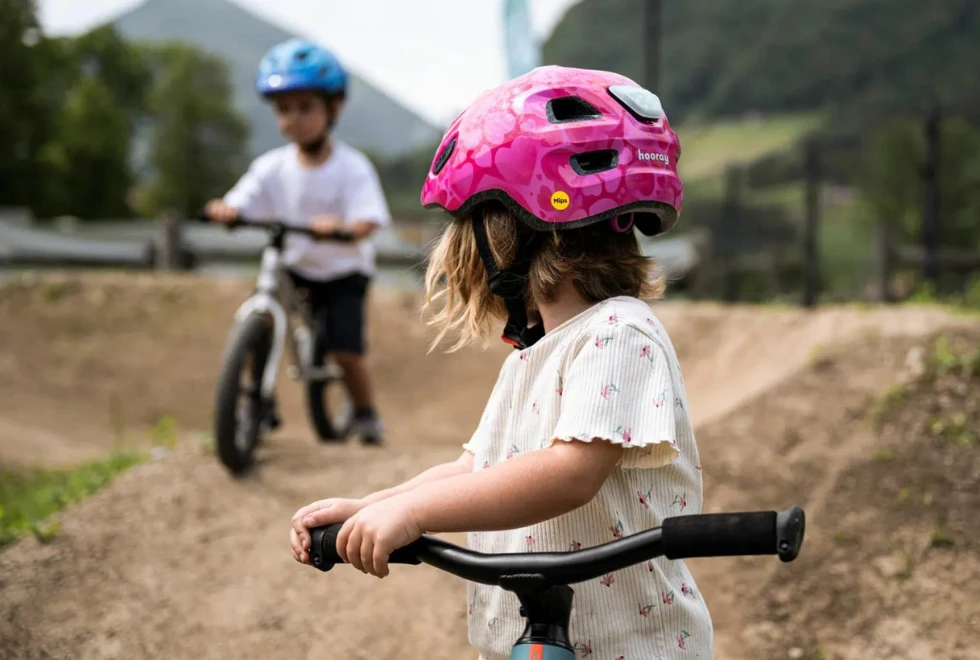
To teach a child how to ride a bike, our advice is to skip the training wheels step and go directly from the balance bike to a pedal bike. In fact, with the balance bike, the child gains confidence, coordination of movements, and the ability to maintain balance, making it easier to transition directly to a regular children's bicycle.
Once they understand how to maintain balance and how to brake using the controls (and not with their feet as they were used to doing with the balance bike), you can try encouraging them to start on their own by choosing one of the following methods:
the child can start pushing off with their feet and then, once they reach a good speed, place their feet on the pedals;
the child can keep the bike braked, place one foot on the pedal, release the brake, and then push off to gain momentum, afterwards they can try to place the other foot on the pedal as well;
the child can place one foot on the pedal while pushing off the ground with the other foot, only when they have reached a decent speed can they try to place the second foot on the pedal.
It is very important to trust the child, make them feel safe and encouraged, aware that the first falls will certainly occur, but there will also be plenty of fun and satisfaction!
It may be easier for a child to learn to ride a bike: their carefree nature, desire to have fun, and reduced sense of danger are advantageous and make everything simpler. However, an adult can also learn to ride a bike; it will require motivation, the right tips, and a bit of training. As seen for children, when teaching an adult to ride a bike, we recommend starting by helping them get comfortable with the bike and finding their balance on their own, initially by just pushing themselves with their feet (so at this stage, it’s good to adjust the saddle so that the aspiring cyclist can place the sole of their foot completely on the ground). Once they have gained some confidence with the bike and are familiar with using the brakes and gears, you can suggest they try pedaling alone, ideally on a flat, smooth, and safe path.
They will then need to put one foot on one of the pedals and push off with the other foot until they achieve a dynamic balance that allows them to lift their foot off the ground to the second pedal. And after a bit of practice, and perhaps some falls, they will be ready to become an experienced cyclist!